Politics, Government & Public Policy: March 2016 Archives
So writes David Lightman about the rubes in St. Louis.
Clinton was paid $675,000 for three Goldman Sachs speeches behind closed doors in the years after she left her job as secretary of state in 2013. She demanded transcripts be kept, and so far refuses to release them publicly.Andrew Williams, Goldman Sachs spokesman, explained, "Clinton spoke at conferences that we hosted for clients. We host literally hundreds of conferences around the world and continually search for fascinating speakers." Such speeches are commonplace, he said, and singling out Clinton's talk is "misleading."
I think most people can "fathom" why the Clintons get paid more than the value of an average American house for a 30-minute speech: it's a bribe. It's buying the favor of some of the most powerful people in the world. That isn't hard to understand.
(HT: Ed Driscoll.)


It's hard to think of a stronger endorsement for Trump than the numerous Wall Streeters who don't like him.
"I can't find connective tissue between the financial sector and Trump," said one senior industry official, who spoke on the condition of anonymity to avoid being seen publicly questioning Trump. ..."Wall Street works in close collaboration between policymakers and markets, and Trump is a disrupter," said Peter Kenny, a 20-year Wall Street veteran. "Just because he's a billionaire does not mean that he is part of the team."
What's more, the short snippet about Trump's relationship with Deutsche Bank strikes me as complimentary.
Trump had personally guaranteed $40 million of Deutsche's $640 million construction loan for the project. When a payment came due in November 2008, the billionaire asked for an extension. Deutsche refused, and Trump sued for $3 billion, condemning the bank's "predatory lending practices."Deutsche countersued and did not hold back in asking that Trump's suit be thrown out. "Trump is no stranger to an overdue debt," the company said in one filing. "This suit is classic Trump."
Trump and Deutsche Bank, which declined to comment for this article, finally reached an agreement in August 2010 that extended the loan for five years. It has since been paid off.
Eventually both sides patched things up. Trump and his daughter Ivanka are building a $200 million luxury hotel at the Old Post Office Pavilion in the District. Trump has said he is investing $42 million of his own money into the project.
There is just one loan: $170 million from Deutsche Bank.
I wonder if Trump will be able to mend fences with the Republican elites and general voters who don't like him now?
I agree with law professor Glenn Reynolds: it's bad that American is entirely dominated by lawyers. Put some non-lawyers on the Supreme Court.
But law is supposed to govern everyone's actions, and everyone is supposed to understand it. ("Ignorance of the law," as we are often told, "is no excuse.") But when the Supreme Court is composed of narrowly specialized former judges from elite schools, the likelihood that the law will be comprehensible to ordinary people and non-lawyers seems pretty small. (In addition, a recent book by my University of Tennessee colleague Ben Barton makes a pretty strong case that lawyer-judges systematically favor the sort of legal complexity that, shockingly, makes lawyers rich. He, too, recommends non-lawyer judges, which, as he notes, are common in other nations and were common in colonial America.)The Supreme Court is one-third of the federal government, and the other two branches, Congress and the presidency, are already dominated by lawyers. But there are hundreds of millions of Americans who aren't lawyers, and surely some of them are smart enough to decide important questions, given that the Constitution and laws are aimed at all of us. Shouldn't we open the court up to a little diversity?
Michael Barone continues, "I suspected that Southern blacks tend to be more socially connected, especially through churches, than Northern blacks."
I thought of all these things, too! And so many more things. Smart things. So many smart things that I don't have time to write them all down! But when I see someone else come along behind me and write down something that I've already thought of, it prompts me to point out to everyone that I had that thought first. Just for the sake of historical accuracy.
The Republican elites are making plans to prevent the nomination of Donald Trump. Unfortunately, they completely misdiagnose the illness in the party.
Other governors voiced exasperation not only at the prospect of a Trump nomination but also at the political culture that gave rise to his candidacy."We've got this Enquirer magazine mentality," Gov. Gary R. Herbert of Utah said in an interview. "We are subject to this reality-TV voyeurism that is taking place. Fast-food headlines, no substance, all flash. The Twitter atmosphere out there, snarky comments on email, Snapchat. Everything is superficial. . . . We've got to wake up, America."
To these governors, the problem is the voters, the media, the culture... never themselves. It's impossible for them to recognize that Trump's rise was fueled by the persistent refusal of the Republican elite to listen to the will of the members of their party. This willful blindness is why Trump is running so strong.
Kurt Schlichter writes that Republican elites have no one but themselves to blame for Trump's rise.
Think of this as, in large part, the struggle between the haves and have nots of globalization. Amnesty was a great idea for bubble people who think illegal immigration satisfies some sort of libertarian ideal, or who only experience its impact by being able to hire a cheaper nanny. It's a pretty great idea for the illegals too. But leave your nice neighborhood and go where a high school grad who was born here can't get a job as a roofer since any general contractor who doesn't hire illegals is going to go broke because his competition will. Tell somebody whose daughter is shot dead in front of him by an illegal who got arrested five times but never got deported that it's an act of love.If we had built the damn wall we promised our base back then, we probably wouldn't have that damn Trump now.
Free trade is great, in a macro sense. It sure helps enrich the donor class. But go tell the guy who lost his $25 an hour job because NAFTA let Carrier move its air conditioning plant to Mexico about Milton Friedman's "Free to Choose." What's he free to choose? Long-term unemployment? Making a fake Social Security disability claim? Or taking a job greeting at Wal-Mart for $8 an hour?
Immigration and free trade are generally good, but they impose real costs and our base is getting handed the bill. These folks have been asking us for help, and what was our response? Shut up, stupid racists. Well, they finally found someone who is taking their side. His name is Donald Trump, and we made him possible. Hell, we made him inevitable.
Seems right to me.
Allahpundit writes that thanks to early voting, Cruz has no chance to win Florida, making it a likely win for Trump no matter what Rubio does.
You can see what sort of dynamic is shaping up here and why Trump stands to benefit most from it. A private poll taken yesterday of Florida had the race Trump 35, Rubio 30, Cruz 16. It seems safe to assume, after last night's results, that some Rubio voters will conclude that Cruz is the only game in town now if you want to beat Trump. Their votes will shift -- but others will stay put due to Rubio's stronger-than-usual support in his own backyard. And don't forget: Thanks to early voting, many votes in Florida have already been banked for Rubio (and for Trump, of course). Even if his fans choose to desert him and vote strategically for Cruz, there may be five or six percent already on the books that are committed to Rubio and can't be changed. What's shaping up here, in other words, is a dynamic where Cruz wins a bigger share of the vote in Florida than everyone expects but not so much that he manages to consolidate all of Rubio's support, especially once you factor early voting in, thus producing ... a narrow Trump victory, possibly along the lines of Trump 37, Rubio 29, Cruz 25. In a state that awards its delegates proportionally, that would be no big deal. Trump would finish with an extra 10 delegates or whatever. But Florida is winner-take-all; if the vote goes the way I'm imagining, with conservatives stalemated between Cruz and Rubio, Trump gets 99 delegates for his trouble. That alone is eight percent of the total he needs to clinch the nomination. It'd be a disaster for anti-Trumpers.
Scott Adams makes a strong point: if you're losing, you need to take chances if you want to win. You can afford to play it safe when you're in the lead.
Do you want more risk?Generally speaking, you want to avoid risk when things are going well and accept risk when things are totally broken. If you think the country is doing well, and will continue to do so, Hillary Clinton is an excellent choice on the left, as is Marco Rubio on the right. They will keep things mostly the same.
But if you think government is rigged against your interests, and unlikely to improve on its own, you want a bloodless revolution. And the candidate you hire for the revolution is likely to have rough edges.
Still, I think I prefer Tex Cruz, the less erratic antiestablishmentarian. I disavow all of Trump's racist, xenophobic, crazy remarks.
Barring indictment for Hillary or shenanigans at the Republican convention, it looks like 2016 will be Trump vs. Hillary.
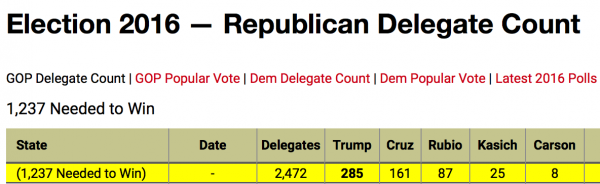
Trump isn't my favorite, but I'm not panicking about his nomination. I'm pretty tired of the Republican elites who have squandered the past 16 years. Let's shake things up! Trump: safer than a civil war or Constitutional convention.
(HT: Instapundit.)
