Why are men being hit harder than women by the ongoing unemployment crisis?

1. Consider the different intelligence distributions of men and women.

Men and women have very similar mean intelligence, but men tend to have greater variance. One consequence of this difference is that there are more very smart and very dumb men, whereas more women are clustered near the mean.

2. As technology continues to improve, more and more workers will be displaced by automated systems. Manufacturing won't be the only sector affected: how many tax preparation jobs have been eliminated by TurboTax? Sales jobs by Amazon?

Using intelligence as a proxy for a person's general capability to contribute to the economy, we would expect that as technology improves the people who will be affected first will be those who are working jobs that require the least capability. Let's call the red line the displacement line: it represents the minimum amount of capability a person must have in order to be able to do a job that cannot be done by an automated system.
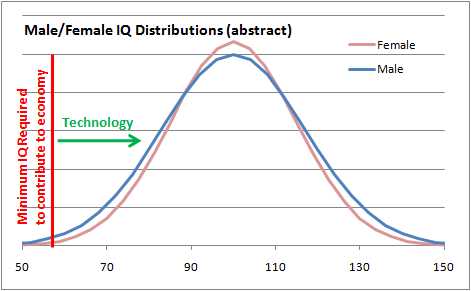
Historically the red line has been far to the left: for most of human history even a very unintelligent person has been able to contribute meaningfully to the economy. That is no longer true.

3. Since the red displacement line has not yet reached the mean level of human intelligence, we would expect that more men than women will have been displaced from their jobs by advancing technology. This group of men is represented by the gray cloud I've drawn on the graphic below. The excess of men in this group can be seen as the vertical space between the blue line and the pink line.

As the red displacement line marches to the right with the advance of technology, more and more people will be displaced from the workforce and will be functionally unable to contribute meaningfully to the economy.

Predictions:

4. Men are disproportionally affected now, but when automated systems can displace people with average intelligence or greater it will be women who will face disproportionate pressure.

5. Even if technology advances at a linear rate, the number of people displaced from the workforce will increase faster than linearly until automated systems surpass the capabilities of the average human.

6. If Singularity proponents are right, we might be extremely fortunate to live in the small window of history that has both advanced technology and such poor automated systems that most humans can make a contribution to the world. For most of the past the red line has been far to the left, and for most of the future the red line will be far to the right.

0 TrackBacks

Listed below are links to blogs that reference this entry: Unemployment, Technology, IQ, and Gender.

TrackBack URL for this entry: http://www.mwilliams.info/mt5/tb-confess.cgi/7676

4 Comments

Excellent reasoning. While I was familiar with the general notion you're getting across, I'd never really considered it in the context of the different IQ distributions of men and women. The social implications of this may be pretty nasty, especially as it's not just men and women who have different IQ curves, but also different ethnic and racial groups. Curve differences there vary not just in variance, but also the location of the peak.

Our greatest hope here is that bio and computer technology will reach the point where we can start changing the shapes of those curves, before that line passes beyond the farthest extent of the curve. Which it will, eventually, if we don't start improving ourselves.

This is why fears about population fall are maybe misplaced. We don't need huge populations any more.

I think prediction 4 is slightly off: women are affected more than men as the red line moves between the two intersections on your IQ curves; once the machines are sufficiently capable then men will be affected more than women again.

I also question 5: I wonder if a the relationship between technological complexity and the IQ of the worker that technology can replace is linear. I have a feeling that advancing technology from equiv. IQ 90 to 110 will be far more challenging than advancing from say 50 to 70.

I also have a more optimistic outlook on 6: I think living in a world where economic input is impossible could be fantastic. I can imagine a world where work would be purely for pleasure, where there's so much of everything that the notion of wealth is obsolete. That's hopelessly naive, but we all are. Machines of such utility would change the game at least as much as the industrial revolution did.

I agree with you that IQ is at best a proxy: it's obvious that we'll still get eg. desirable art from people with unexceptional IQ.

The basic problem with population falls, and the reason they certainly do matter right now, is that people age, and become dependent. And if your population is going to fall by, say, 10%, 10% of the old people don't magically vanish, just because you had 10% fewer children.

The result is that, when a population is declining, especially when medical care is improving, it dramatically increases the ratio of dependent to productive people. Some nations deal with this by importing young people, and just end up replacing their own culture with the culture of the imports. Japan is trying to deal with it by advanced robotics, (Because they're xenophobic, so immigrants aren't an acceptable solution.) and they're in a race against time to get the robots advanced enough before they run out of nurses.

But how ever you plan to deal with it, it's a serious problem.

And if you do solve it with robots, you better be awfully certain that robots as smart as people are willing to work for people, and not demand equal rights.

If there's one thing I can't stand it's xenophobia. And the Japanese...

"you better be awfully certain that robots as smart as people are willing to work for people, and not demand equal rights."

I've never been able to take this threat seriously, although it's an excellent device in sci-fi literature to examine human psychology. More realistic to me is the robot who is convinced that it knows best what's good for us, such as in Asimov's The Evitable Conflict.

Leave a comment

The comment login system is acting strange. If you get an error message saying you aren't logged in when you are, just reload the comment page and try again. I'm trying to track this bug down, but it's not easy.

Supporters

Email plasticATgmailDOTcom for text link and key word rates.

Site Info

Support